This trend is no longer active
This trend was archived on Dec 25, 2025 as it is no longer seeing new developments.
Enterprise AI Agents Drive Strategic Automation Revolution
Main Take
AWS's launch of new AI models and infrastructure underscores a fierce competition for dominance in agentic AI. The trend reveals a shift toward autonomous AI agents, capable of handling complex tasks across industries. Watch for deeper integrations of AI agents in enterprise applications, reshaping workflows and interactions.
Who Should Care
Expect increased funding in AI infrastructure as competition heats up.
Research on interoperability standards for AI agents will gain urgency.
Focus on building robust, scalable AI solutions is critical for future projects.
Related Articles (23)
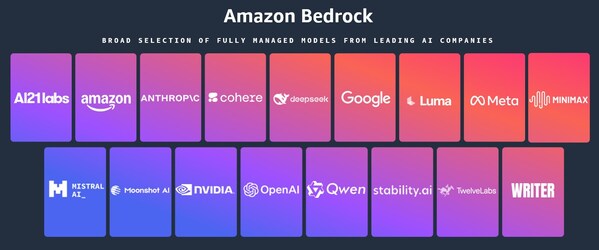
Amazon Bedrock adds 18 fully managed open‑weight models from leading AI providers
Amazon Web Services has expanded Amazon Bedrock with 18 additional fully managed open‑weight models from providers including Mistral AI (Mistral Large 3 and the Ministral 3 series), Google (Gemma 3), Moonshot AI (Kimi K2 Thinking), MiniMax (MiniMax M2), NVIDIA (Nemotron), OpenAI (GPT OSS Safeguard) and Qwen. The move brings Bedrock’s catalog to nearly 100 serverless models, reinforcing AWS’s strategy of offering enterprises a broad, switchable model lineup for agentic workflows, multimodal reasoning, coding assistance and content safety without changing application code.
U.S. Army taps C3 AI to build agentic logistics solution for contested combat environments
C3 AI announced that the U.S. Army Rapid Capabilities and Critical Technologies Office has selected it to deliver an AI-powered contested logistics application that forecasts parts, fuel and munitions needs for brigades operating in high‑risk environments. The system will integrate into command-and-control networks and combines components of C3 AI’s Contested Logistics and Readiness products, using generative and agentic AI to improve resupply planning and operational tempo.
Linux Foundation launches Agentic AI Foundation with backing from Anthropic, OpenAI and Block
The Linux Foundation announced the Agentic AI Foundation (AAIF), a new directed fund to steward open standards and infrastructure for agentic AI systems. Founding contributions include Anthropic’s Model Context Protocol (MCP), Block’s goose framework, and OpenAI’s AGENTS.md spec, with support from Google, Microsoft, AWS, Bloomberg and Cloudflare, aiming to make AI agents interoperable, vendor‑neutral and safer at scale.
Accenture and Anthropic expand partnership to train 30,000 staff on Claude and co-sell enterprise AI
Accenture and Anthropic announced a multi‑year expansion of their partnership that will see around 30,000 Accenture employees trained on Anthropic’s Claude models and Claude Code. The firms will jointly develop and sell AI solutions across industries, including regulated sectors like financial services, healthcare and the public sector, reflecting growing enterprise demand for agentic coding assistants and workflow automation.

Accenture and Anthropic form dedicated business group to scale enterprise AI with Claude
Accenture and Anthropic announced a multi‑year expansion of their partnership, creating the Accenture Anthropic Business Group to train around 30,000 Accenture professionals on Claude and Claude Code. The collaboration aims to make Anthropic one of Accenture’s key strategic AI partners, embed Claude across Accenture’s innovation hubs, and co‑develop solutions for regulated sectors to help enterprises move from AI pilots to large‑scale deployments.
AWS weekly roundup highlights agentic AI push and new multimodal Bedrock capabilities after re:Invent
AWS published its December 8 weekly roundup synthesizing key announcements from re:Invent 2025, emphasizing AI agents as a new inflection point and promoting the Kiro Autonomous Agent as Amazon’s standard internal AI development environment. The post also spotlights multimodal retrieval for Amazon Bedrock Knowledge Bases and a preview of AWS Interconnect – Multicloud, framing these launches as foundational infrastructure for building production‑scale agentic AI systems.

AWS’s Nova Forge platform pitches custom frontier‑scale models built on enterprise data
Commentary in South Africa’s Sunday Times highlights Amazon Web Services’ new Amazon Nova Forge platform, unveiled at re:Invent, which lets enterprises integrate their own data into the training of high‑end models to create proprietary AI systems. Analysts quoted in the piece say Forge, along with AWS’s new Frontier Agents and Transform tools, could reposition AWS in the AI race by focusing on end‑to‑end enterprise model lifecycle and migration off legacy systems rather than chasing headline public models.

AWS re:Invent 2025 showcases new infrastructure for agentic AI workloads
At AWS re:Invent 2025, Amazon Web Services highlighted a slate of new services aimed at "agentic" AI — autonomous AI agents that can carry out multi‑step tasks — including Amazon S3 Vectors for vector search over enterprise data, new EC2 Trn3 UltraServers optimized for large‑scale model training and inference, and M9g instances powered by the latest Graviton5 CPUs. The announcements underscore AWS’s push to provide a full stack for building and scaling AI agents, from specialized hardware to data infrastructure, as hyperscalers compete to own the generative and agentic AI platform layer.

Agents-as-a-service poised to reshape enterprise software and corporate structures
A CIO feature argues that autonomous AI agents delivered as “agents-as-a-service” are rapidly emerging on top of traditional SaaS, with more than half of surveyed executives already experimenting with AI agents for customer service, marketing, cybersecurity and software development. Drawing on forecasts from Gartner and IDC, it predicts that by 2026 a large share of enterprise applications will embed agentic AI, shifting user interaction away from individual apps toward cross‑app AI orchestrators and forcing CIOs to rethink pricing, integration and security models. ([cio.com](https://www.cio.com/article/4098664/agents-as-a-service-are-poised-to-rewire-the-software-industry-and-corporate-structures.html))

Mantel Group signs three‑year strategic AI collaboration agreement with AWS
Australian consultancy Mantel Group has signed a three‑year strategic collaboration agreement with AWS focused on building and deploying generative and agentic AI solutions using services including Amazon Bedrock, Amazon Q and SageMaker. The partnership aims to speed up AI adoption for enterprise customers in Australia and New Zealand, building on previous joint projects such as a gen‑AI claims‑processing system for health insurer nib Group.

Amazon outlines $12.7 billion AI and cloud infrastructure push in India to reach 15 million SMBs and 4 million students
Amazon reaffirmed plans to invest $12.7 billion in local cloud and AI infrastructure in India by 2030, aiming to bring agentic and generative AI tools to 15 million small businesses and AI literacy programs to 4 million government‑school students. The initiative expands AWS data‑center capacity in Telangana and Maharashtra and rolls out AI‑powered seller tools, shopping assistants like Rufus and Lens AI, and large‑scale education programmes aligned with India’s national AI and education strategies.
Amazon showcases Nova generative AI with custom perfume lab and new SageMaker capabilities at AWS re:Invent
At AWS re:Invent in Las Vegas, Amazon highlighted new SageMaker AI features for faster customization of AI models while drawing crowds to an experiential ‘Eau de AI’ perfume lab powered by its Nova generative AI system. Attendees could verbally describe preferences and have Nova design bespoke fragrances from 30 base scents, illustrating Amazon’s push to demonstrate AI’s creative and commercial applications as it competes with rival cloud providers.

Snowflake and Anthropic sign $200 million multi-year partnership to embed Claude agents in enterprise data cloud
Snowflake and Anthropic expanded their strategic partnership in a multi‑year deal worth $200 million, making Claude models deeply integrated into Snowflake Cortex AI and powering Snowflake’s new “Snowflake Intelligence” enterprise agent. The collaboration aims to help more than 12,600 Snowflake customers deploy agentic AI over governed, sensitive data across all three major clouds, moving AI use from pilots to production in regulated industries.

AWS unveils new Nova 2 AI models, Trainium3 UltraServers and frontier agents at re:Invent 2025
Amazon Web Services announced a major expansion of its AI portfolio at re:Invent 2025, introducing the multimodal Nova 2 Omni model family, new Nova Forge tooling to let customers build custom models, and EC2 Trn3 UltraServers based on its next‑generation Trainium3 chip. AWS also previewed Trainium4 and launched new Bedrock AgentCore capabilities, including policy controls, evaluation tools and memory, plus a new class of autonomous 'frontier agents' and on‑prem 'AWS AI Factories' combining Nvidia and Trainium hardware. These moves aim to deepen AWS’s position in enterprise AI infrastructure and managed model services against rivals such as Microsoft Azure and Google Cloud.
Snowflake and Anthropic sign $200 million multi-year partnership to embed Claude agents in Snowflake’s AI Data Cloud
Snowflake and Anthropic announced a $200 million, multi-year expansion of their strategic partnership that brings Anthropic’s Claude reasoning models and agentic AI directly into Snowflake’s Cortex AI platform for more than 12,600 enterprise customers. The deal is designed to let heavily regulated industries run complex, multi-step analysis on sensitive financial, healthcare and operational data inside Snowflake’s governed environment, while the companies jointly market Claude-powered enterprise data agents worldwide.

AWS debuts Nova Forge, a service for building proprietary frontier‑grade LLMs on enterprise data
Amazon Web Services announced Nova Forge, a new service that lets enterprises blend their proprietary data with AWS‑curated corpora at different checkpoints in a frontier model’s training process, producing custom LLMs that internalize business logic rather than relying solely on RAG or fine‑tuning. The subscription‑priced service is positioned as an "AI factory" play that tightly couples Trainium hardware, SageMaker, and Bedrock, offering a path to high‑precision domain models for regulated sectors like finance, healthcare, industrial control, and large‑scale code assistants.
C3.ai posts fiscal Q2 results and launches agentic process automation solution
Enterprise AI software company C3.ai reported fiscal Q2 2026 revenue of $75.1 million, up quarter-on-quarter, driven by strong growth in its U.S. federal business and partner-led deals. The company also announced C3 AI Agentic Process Automation, a new product that lets organizations describe complex business workflows in natural language and automatically deploy them as autonomous AI agents, signalling a deeper push into agentic AI platforms.

AWS expands Nova 2 AI models, Trainium3 UltraServers and 'frontier agents' at re:Invent 2025
Amazon Web Services used its re:Invent 2025 conference to unveil a Nova 2 family of foundation models (Lite, Pro, Sonic and Omni), new Trainium3 UltraServers built on a 3 nm AI chip, and a class of long‑running 'frontier agents' that act as virtual developers, security engineers and DevOps staff. The company also broadened Amazon Bedrock with 18 additional open‑weight models from partners such as Mistral AI, Google, MiniMax, NVIDIA and OpenAI, and introduced AI governance tools like Bedrock AgentCore Policy, Evaluations and Memory plus on‑prem 'AWS AI Factories' that bundle NVIDIA GPUs, Trainium and Bedrock/SageMaker for sovereign, high‑performance AI infrastructure.([notimerica.com](https://www.notimerica.com/ciencia-tecnologia/noticia-portaltic-aws-presenta-modelos-ia-nova-servidores-trainium3-ultraservers-frontier-agents-20251203125319.html))

AWS unveils frontier AI agents that act as autonomous software team-mates
Amazon Web Services introduced a new class of "frontier agents"—Kiro autonomous agent, AWS Security Agent and AWS DevOps Agent—designed to work as autonomous teammates that can run for hours or days handling coding, security and operations tasks with minimal human oversight. The agents integrate with common developer and ops tools (GitHub, Jira, Slack, CloudWatch, Datadog, etc.) and are pitched as a step-change from task-level copilots toward fully agentic systems embedded across the software lifecycle. ([aboutamazon.com](https://www.aboutamazon.com/news/aws/amazon-ai-frontier-agents-autonomous-kiro))
RapidAI and AWS deepen partnership to scale clinical imaging AI globally
RapidAI and Amazon Web Services announced an expanded partnership at RSNA 2025 to co‑develop advanced clinical imaging AI tools and foundational model infrastructure, backed by AWS’s global cloud and RapidAI’s disease‑specific algorithms. The collaboration aims to make deep clinical AI easier to deploy and scale for hospitals worldwide, improving diagnostic precision and workflow efficiency while keeping data within compliant, secure environments.
Glean earns AWS Agentic AI Specialization for enterprise work AI agents
Work AI platform Glean announced that it has achieved Amazon Web Services’ new Agentic AI Specialization, validating its track record building autonomous AI agents on AWS that can reason over enterprise data, enforce permissions and automate multi‑step workflows. The designation, part of AWS’s expanded AI Competency program, positions Glean as a preferred partner for organisations looking to move from generative‑AI experimentation to production‑grade agentic systems integrated with services like Amazon Bedrock.
Articul8 AI secures AWS Agentic AI Specialization for regulated-industry GenAI
Articul8 AI, which focuses on domain‑specific generative AI for highly regulated sectors, announced that it has achieved AWS’s Agentic AI Specialization, recognising its expertise in deploying autonomous AI systems on Amazon Bedrock and related services. The company says the specialization will help customers in industries like financial services and healthcare build AI agents that integrate with existing ERP, CRM and data‑lake systems while meeting strict governance and compliance requirements.

Comprinno signs two-year Strategic Collaboration Agreement with AWS to accelerate generative AI in India
Indian cloud and AI advisory firm Comprinno has signed a two‑year Strategic Collaboration Agreement (SCA) with Amazon Web Services (AWS) to speed up generative AI adoption and cloud modernization across Indian enterprises. Under the deal, Comprinno will combine its software and data engineering expertise with AWS’s Bedrock and other GenAI services to build and scale enterprise‑grade AI solutions in sectors including finance, retail, logistics and healthcare.
Discussion
Key Players
Advances AGI Timeline
This trend may accelerate progress toward AGI
AWS's launch of new AI models and infrastructure underscores a fierce competition for dominance in agentic AI. The trend reveals a shift toward autonomous AI agents, capable of handling complex tasks across industries. Watch for deeper integrations of AI agents in enterprise applications, reshaping workflows and interactions.
Timeline
22 eventsAmazon Bedrock adds 18 managed open-weight models
Amazon Bedrock's expansion with 18 new models enhances its AI offerings, impacting users and developers.
U.S. Army selects C3 AI for logistics solution
C3 AI's selection to build a logistics application for the U.S. Army represents a significant government contract and application of AI in military logistics.
Linux Foundation launches Agentic AI Foundation
The establishment of the Agentic AI Foundation indicates a strategic move towards standardizing agentic AI systems.
Accenture and Anthropic expand partnership
The partnership expansion to train 30,000 staff indicates a significant commitment to integrating AI solutions in enterprise environments.
Accenture and Anthropic form dedicated business group
The creation of a dedicated business group signifies a strategic focus on scaling enterprise AI solutions.