OpenAI's Bold Leap in Mathematical AI Research
Main Take
OpenAI's release of over 700 math manuscripts showcases its frontier AI model's capabilities. This initiative not only addresses open problems in mathematics but also invites scrutiny and collaboration from the mathematical community. The move could accelerate the pace of mathematical discovery, pushing the boundaries of what AI can achieve in this field.
The Story So Far
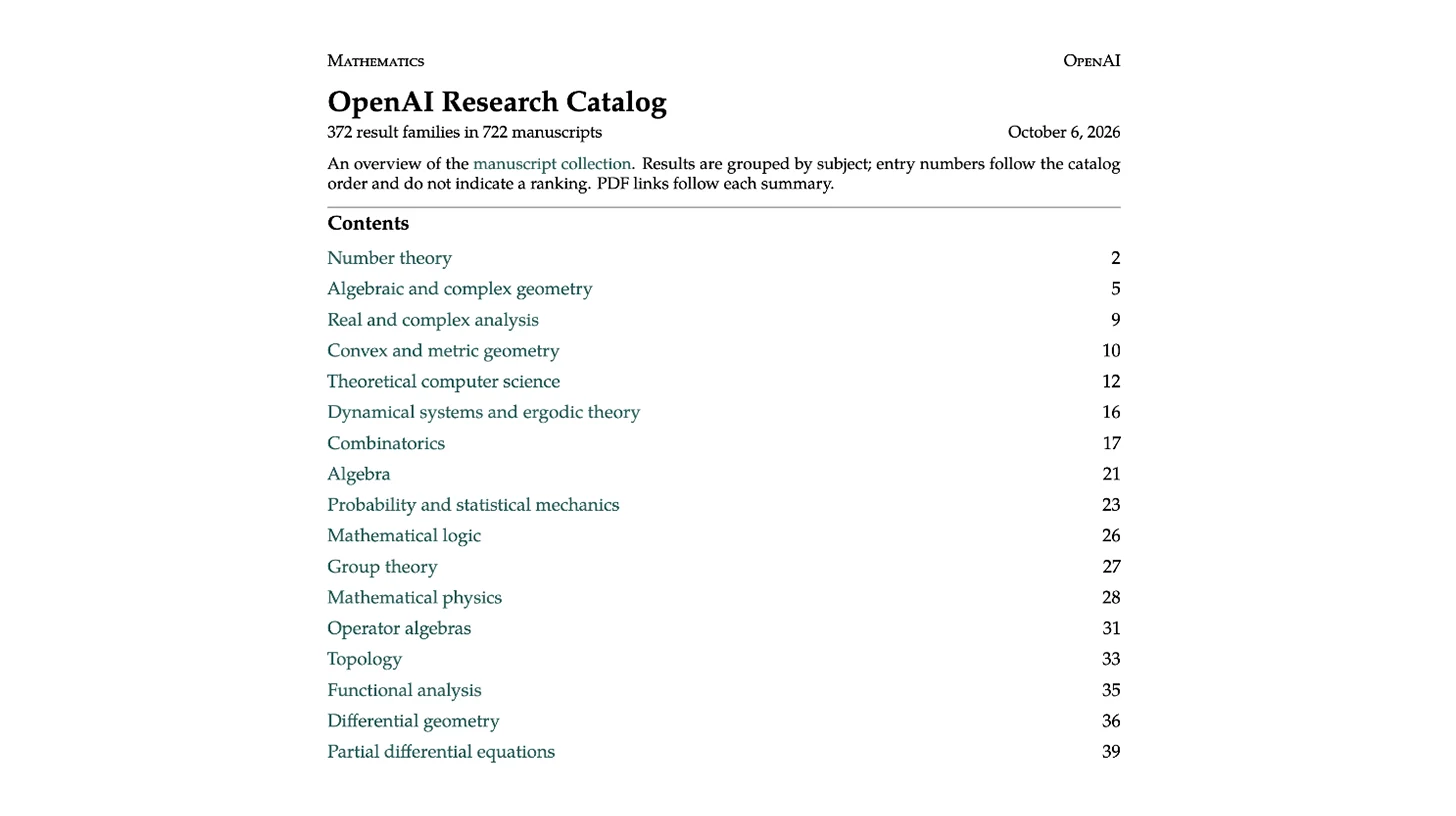
OpenAI's recent release of 722 AI-generated mathematical manuscripts marks a significant milestone in the intersection of artificial intelligence and mathematics. On October 6, 2026, OpenAI unveiled these manuscripts, which were produced by an advanced internal AI model. The papers, organized into 372 families of results, cover a wide range of topics, including algebra and geometry, and are now available on GitHub for public review. This initiative aims to tackle hundreds of unresolved problems in mathematics and theoretical computer science, inviting mathematicians worldwide to audit, extend, or challenge the AI-generated proofs.
The release has garnered international attention, with coverage from various outlets, including Indian and Chinese media. Reports highlight the potential implications of these manuscripts for the mathematical community, emphasizing the importance of transparency and collaboration in validating AI-generated research. The Lean formalizations accompanying the manuscripts allow for rigorous verification, setting a precedent for future AI contributions to academic research.
This development is crucial as it not only showcases the capabilities of OpenAI's frontier model but also raises questions about the role of AI in traditional research domains. By democratizing access to advanced mathematical proofs, OpenAI is positioning itself as a leader in AI-driven research, potentially reshaping how mathematical problems are approached and solved. The stakes are high, as success in this venture could lead to groundbreaking discoveries and further establish AI as an essential tool in academic research.
Looking ahead, the mathematical community will be watching closely to see how researchers engage with these manuscripts. Will they embrace this new tool, or will skepticism prevail? The response to OpenAI's initiative could set the tone for future AI contributions in various academic fields.
Who Should Care
Expect increased interest in AI-driven research tools and platforms.
This release opens new avenues for collaboration and verification in mathematical research.
Engineers should explore the implications of AI-generated proofs on software development and algorithm design.
Related Articles (4)
OpenAI math model generates 722 papers and Lean checked proofs
OpenAI disclosed on October 6 that an internal model generated 722 math manuscripts grouped into 372 families of results, based on roughly 4,000 problems posed to it. On October 9, The Rundown AI reported that OpenAI released the manuscripts and a Lean formalization catalogue on GitHub, including a claimed proof of a “quasi Riemann hypothesis.”

OpenAI releases 722 AI generated math manuscripts to GitHub
Chinese outlet Softunis reports that on October 7, 2026, OpenAI released more than 700 mathematics research manuscripts, all generated by an unreleased internal AI model, covering areas such as algebra and geometry. Independent English coverage says 722 manuscripts organised into 372 families were published in a public GitHub repository alongside a note on “Sharing AI progress in mathematics.”
OpenAI frontier math model publishes 722 proof manuscripts
On October 6, 2026 OpenAI published 722 math manuscripts, grouped into 372 result families, produced by an internal frontier AI model. The Indian Express reported the release on October 7, 2026 at 08:44 AM IST, highlighting claims of progress on hundreds of open problems in mathematics and theoretical computer science.
OpenAI publishes 700 plus AI generated math manuscripts on GitHub for verification
OpenAI’s October 6, 2026 research release detailing 722 mathematical manuscripts from an internal frontier model is now being widely covered on October 8, 2026, including in French outlet Stynx. The company has posted the papers, Lean formalizations and methodological notes in a public GitHub repository so mathematicians can audit, extend or refute the AI produced proofs.
Discussion
Key Players
Advances AGI Timeline
This trend may accelerate progress toward AGI
OpenAI's release of over 700 math manuscripts showcases its frontier AI model's capabilities. This initiative not only addresses open problems in mathematics but also invites scrutiny and collaboration from the mathematical community. The move could accelerate the pace of mathematical discovery, pushing the boundaries of what AI can achieve in this field.
Timeline
1 eventOpenAI publishes 722 AI-generated math manuscripts on GitHub
The release of 722 math manuscripts represents a significant achievement in AI-generated research, showcasing the capabilities of OpenAI's frontier model.