AI Futures Model pushes full coding automation forecast to 2031
TL;DR
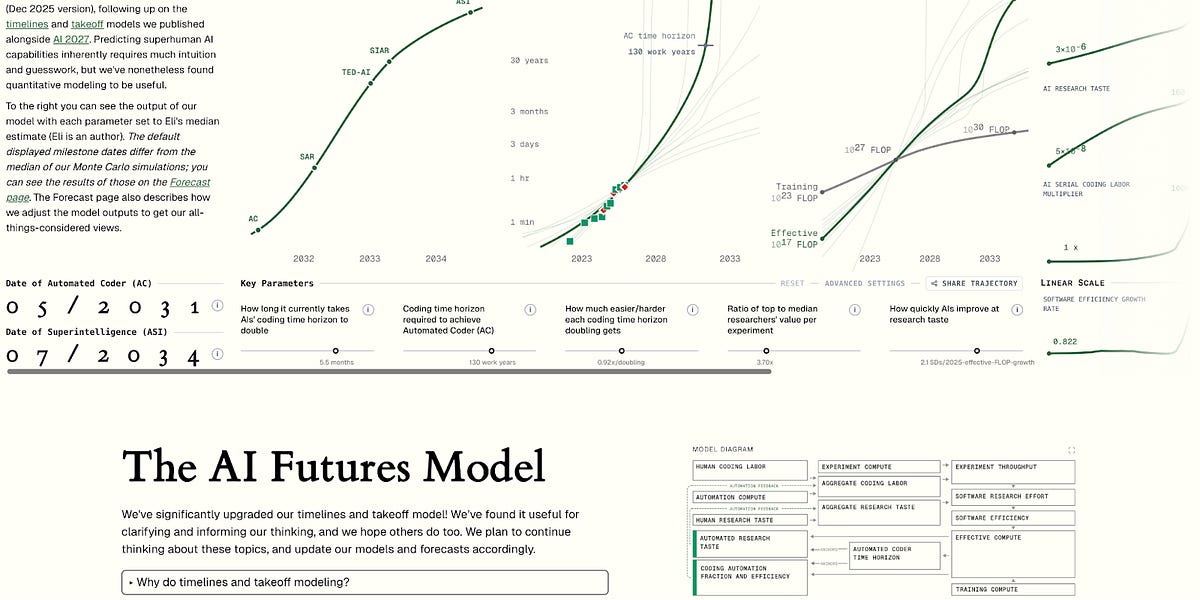
On December 31, 2025, the AI Futures Project released a major update to its quantitative AI timelines and takeoff model. The new model shifts the median forecast for fully automated coding from roughly 2027–2028 to around 2031, while still projecting rapid capability growth and a superintelligence median in the mid-2030s.
About this summary
This article aggregates reporting from 2 news sources. The TL;DR is AI-generated from original reporting. Race to AGI's analysis provides editorial context on implications for AGI development.
Race to AGI Analysis
The updated AI Futures Model is one of the few serious attempts to turn AGI timelines and takeoff scenarios into a quantitative, end‑to‑end story. The headline result—a median shift for fully automated coding out to roughly 2031—doesn’t mean AI progress slowed in 2025. Instead, the authors conclude their earlier modeling probably overestimated how quickly partially automated AI R&D loops would compound into full automation.([blog.ai-futures.org](https://blog.ai-futures.org/i/182911449/timelines-and-takeoff-forecasts))
For the race to AGI, that’s a quietly important narrative correction. Frontier labs and many market participants have been operating on extremely aggressive 2027‑ish timelines for “AI can write all the code,” which drove some of 2025’s exuberance in funding, hiring, and infrastructure build‑out. A 3–4 year delay still leaves timelines short by historical standards, but it buys a sliver more time for safety research, policy, and institutional adaptation. Crucially, the model keeps post‑automation takeoff relatively fast and still lands median ASI around 2034, reminding us that a slightly later start doesn’t necessarily mean a slow finish.([blog.ai-futures.org](https://blog.ai-futures.org/i/182911449/timelines-and-takeoff-forecasts))
Who Should Care
Related News

Vibe coding trend shows how AI reshaped software work in 2025
Today
China 2049 tech vision forecasts AGI, robots and smart cities
Today