Global AI Adoption Reaches Critical Mass
Main Take
AI tools are now integral to many workplaces. In Europe, 20% of companies are using AI, with adoption rates soaring in Nordic countries. The UAE boasts nearly 60% of its population using AI, showcasing a global trend toward widespread integration of these technologies.
The Story So Far
AI adoption has reached a pivotal moment globally, with significant strides in both Europe and the UAE. Recent Eurostat data reveals that 25% of Europeans aged 16–74 used generative AI tools for personal purposes in 2025, while 20% of EU companies with at least 10 employees have integrated AI into their operations. This marks a notable increase from 13.5% in 2024, highlighting a rapid shift towards AI in business processes. Nordic countries lead the charge, with Denmark at 42%, Finland at 37.8%, and Sweden at 35%. Meanwhile, Spain's adoption rate stands at 20.3%, aligning closely with the EU average.
In South America, a survey by IBM indicates that over 90% of Chilean office workers utilize AI tools, enhancing their productivity. However, challenges like insufficient training and privacy concerns hinder full potential. In Asia, a Robert Walters survey shows that 58% of employers in Hong Kong have adopted AI, with nearly half aiming to optimize headcount. This trend is reshaping workforce dynamics, with a growing demand for specialists in data science and machine learning.
The UAE emerges as a global leader in AI usage, with nearly 60% of its population engaging with AI tools. This is part of a broader trend, as global AI adoption among working-age adults has tripled since 2022, reaching around 15%. However, usage remains concentrated in specific regions, particularly in tech hubs like San Francisco, New York, London, and Beijing.
The stakes are high. Companies that fail to adapt risk falling behind as AI becomes a cornerstone of operational efficiency. The disparity in adoption rates across regions suggests that while some countries are reaping the benefits of AI, others may struggle to catch up. Watch for continued investment in AI training and infrastructure as businesses seek to harness this technology effectively.
Who Should Care
Expect increased funding in AI training and infrastructure.
AI's rapid adoption will fuel demand for innovative research.
Skills in AI tool integration will be crucial for career growth.

Related Articles (6)
Eurostat data shows 25% of Europeans now use generative AI
Eurostat data reported by French outlet L’Usine Digitale on January 1, 2026 show that about 25% of Europeans aged 16–74 used generative AI tools like ChatGPT for personal purposes in 2025, while 15% used them at work. Adoption is uneven across the EU, with some member states significantly above or below the average.
Eurostat: one in five EU firms now deploys AI tools in operations
Italian education outlet Orizzonte Scuola reports Eurostat data showing that in 2025, 20% of EU companies with at least 10 employees use artificial intelligence, up from 13.5% in 2024. Nordic countries lead adoption, with Denmark at 42%, Finland at 37.8% and Sweden at 35%.

One in five EU companies now uses AI, with Spain at 20.3% adoption in 2025
Citing new Eurostat data, La Nación reports that 20% of EU companies with at least 10 employees used artificial intelligence in 2025, up from 13.5% in 2024, with Spain at 20.3%—roughly in line with the EU average. Adoption is highest in northern Europe (e.g., Denmark 42%, Finland 37.8%, Sweden 35%) and much lower in countries such as Romania and Bulgaria, while common use cases include automatic text analysis, generative media and speech-to-text, underscoring how AI is rapidly diffusing into mainstream business processes across the bloc.

IBM survey: AI tools widely adopted by Chilean workers but skills gaps limit full potential
IBM released survey results showing that more than 90% of Chilean office workers already use AI tools, with most reporting faster task completion, better workload management and improved accuracy. However, over half cite insufficient training, privacy concerns and integration challenges as major obstacles, prompting IBM to recommend stronger upskilling programs, data governance and clearer AI roadmaps for Chilean businesses.

Survey: Nearly half of employers using AI aim to optimise headcount, reshaping workforce structures
A Robert Walters Hong Kong survey finds that 58% of employers have introduced AI in the workplace and, among them, 49% explicitly target headcount optimisation. While support and IT roles see the most automation pressure, demand is rising for specialists in data science, machine learning and AI product development, and most employees expect AI to positively impact their careers if they can reskill in time.
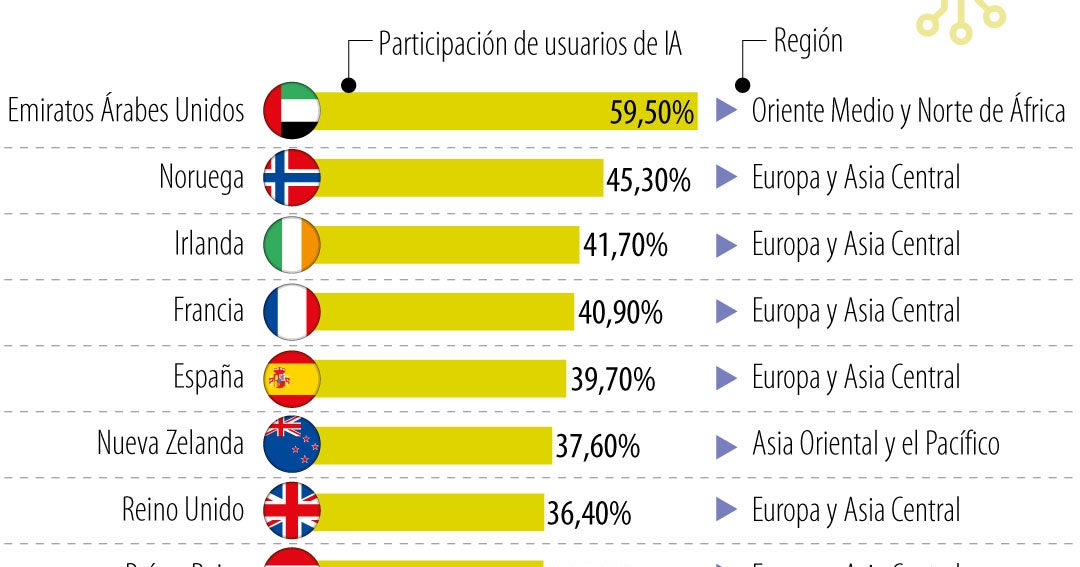
UAE tops global AI adoption as one in seven workers worldwide uses AI, Microsoft study finds
A new Microsoft-backed report highlighted by Colombia’s La República finds that the United Arab Emirates leads the world in AI adoption, with nearly 60% of its population using AI tools, followed by Norway, Ireland and France. Globally, AI adoption among working-age adults has tripled since 2022 to around 15%, but usage remains highly uneven and concentrated in a handful of countries and cities such as San Francisco, New York, London and Beijing.
Discussion
Advances AGI Timeline
This trend may accelerate progress toward AGI
AI tools are now integral to many workplaces. In Europe, 20% of companies are using AI, with adoption rates soaring in Nordic countries. The UAE boasts nearly 60% of its population using AI, showcasing a global trend toward widespread integration of these technologies.