Chinese editorial urges deep AI fusion across all industries
TL;DR
On March 7, 2026, China’s Guangming Daily ran a feature arguing that AI should be deeply integrated into sectors from manufacturing and finance to healthcare. The piece, re‑posted by Nankai University, highlights ‘embodied intelligence’, regulatory sandboxes and sector‑specific medical AI models as priorities for 2026.
About this summary
This article aggregates reporting from 1 news source. The TL;DR is AI-generated from original reporting. Race to AGI's analysis provides editorial context on implications for AGI development.
Race to AGI Analysis
Guangming Daily is not a neutral observer; it’s one of the Party’s key ideological outlets. When it devotes a long piece to how AI should ‘deeply integrate’ with industrial workflows, finance, and healthcare—and does so using current policy jargon like ‘embodied intelligence’ and regulatory sandboxes—it’s reflecting and amplifying the official line. The article’s focus on sector‑specific medical models, national AI health platforms and traceable decision paths shows where Chinese planners think the next wave of value and risk will sit: applied vertical systems, not just headline‑grabbing general models.
For the global AI race, this underscores that China’s strategy is not only about frontier model horsepower; it’s about saturating the real economy with AI‑enhanced processes. If that playbook works, Chinese firms could build huge leads in data‑rich verticals like industrial control, logistics, and clinical decision support. Those domains generate exactly the kind of hard‑mode feedback that pushes models toward more robust reasoning and perception, which will matter even more as we move toward more agentic and embodied systems.
Who Should Care
Related News

OpenAI GPT-5.5 ‘Spud’ leaks hint at omnimodal, agentic frontier model
2 weeks agoDeepSeek V4 to run fully on Huawei Ascend AI chips
2 weeks ago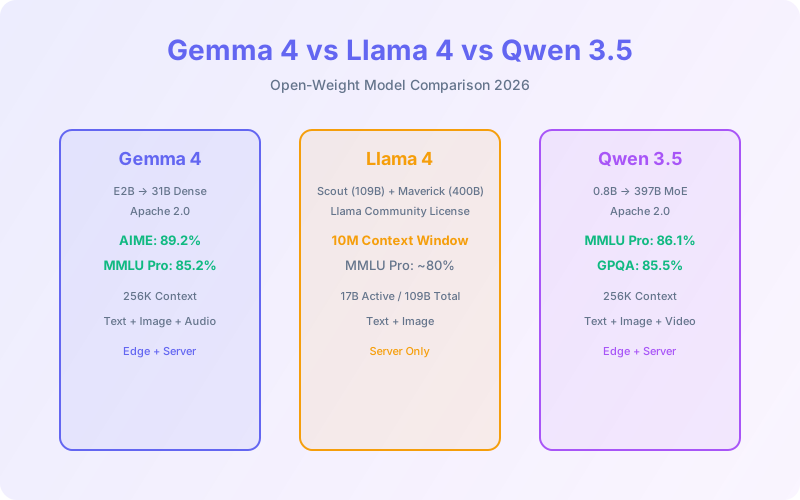
Gemma 4 vs Llama 4 vs Qwen 3.5 open-weight AI showdown
2 weeks ago