Australia uses AI and 3D printing to design extreme-temperature alloys
TL;DR
An OpenGov Asia report on March 7, 2026 highlighted Australian research that combines reinforcement‑learning models with metal 3D printing to design new refractory alloys for extreme environments. The AI system proposes alloy compositions optimized for high-temperature strength and printability, which are then validated via additive manufacturing experiments.
About this summary
This article aggregates reporting from 2 news sources. The TL;DR is AI-generated from original reporting. Race to AGI's analysis provides editorial context on implications for AGI development.
Race to AGI Analysis
On the surface this looks like niche materials science, but AI‑designed refractory alloys speak directly to the physical limits of the AI build‑out. Hyperscale data centers, nuclear‑adjacent cooling systems and hypersonic platforms all rely on materials that can survive enormous thermal and mechanical stress. Using reinforcement learning to search alloy space – and closing the loop with 3D‑printed test parts – is a classic example of AI turning an intractable combinatorial search into an accelerated design cycle.([opengovasia.com](https://opengovasia.com/australia-ai-and-3d-printing-enable-next-gen-materials/))
For AGI, the bottlenecks increasingly sit in power, cooling and physical infrastructure. Any technology that makes turbines, heat exchangers, reactor components or aerospace structures cheaper, lighter or more resilient indirectly expands the feasible envelope for mega‑scale compute. If Australia’s research community can show that AI‑driven alloy design moves the needle on performance or cost, expect similar workflows to be applied to everything from immersion‑cooling fluids to novel conductors.
At the same time, this illustrates a broader trend: AI recursively improving the hardware substrate that itself runs AI workloads. That feedback loop doesn’t dramatically shorten the AGI timeline on its own, but it reinforces a world where model progress is as much about materials and manufacturing innovation as about clever new architectures.
Who Should Care
Related News

OpenAI GPT-5.5 ‘Spud’ leaks hint at omnimodal, agentic frontier model
2 weeks agoDeepSeek V4 to run fully on Huawei Ascend AI chips
2 weeks ago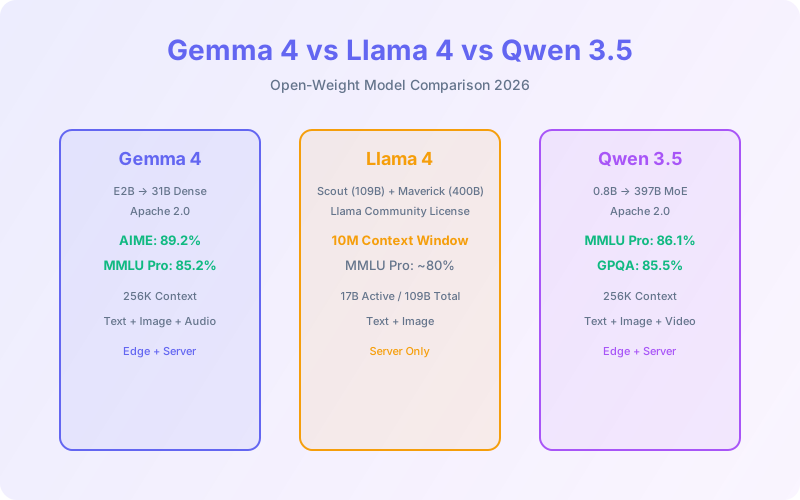
Gemma 4 vs Llama 4 vs Qwen 3.5 open-weight AI showdown
2 weeks ago