Axian Telecom debuts Swahili‑native reasoning AI at MWC Barcelona 2026
TL;DR
On March 6, 2026, Axian Telecom revealed an open Swahili‑native reasoning AI model during Mobile World Congress 2026 in Barcelona. Developed with partners in the GSMA African LLM initiative, the system reasons directly in Swahili, searches the web, and generates structured outputs like business plans and spreadsheets for African users.
About this summary
This article aggregates reporting from 1 news source. The TL;DR is AI-generated from original reporting. Race to AGI's analysis provides editorial context on implications for AGI development.
Race to AGI Analysis
Axian’s Swahili‑native model is a counterweight to the English‑centric trajectory of most large language models. Instead of treating Swahili as an afterthought via translation layers, this system is designed to “think” in the language from the start, which matters for everything from idioms and cultural context to how people in East Africa experience AI‑driven services. As part of the GSMA African LLM initiative, it also shows that telecom operators are no longer just bandwidth providers; they’re becoming language and application platforms in their own right.
For the race toward more capable general intelligence, the technical leap here isn’t about raw scale or benchmark‑topping reasoning. It’s about who gets to participate. By enabling SMEs, public agencies and students to query the web and generate structured outputs in Swahili, Axian is seeding an ecosystem of local workflows and data that can, over time, feed back into better models. That’s strategically important: if African languages remain second‑class citizens, talent and usage will concentrate elsewhere, reinforcing the dominance of a few Western and Chinese labs.
We should expect to see more sovereign, language‑native models across Africa and the Global South. They won’t directly close the gap with frontier AGI systems, but they will broaden the base of users and developers shaping what those systems are asked to do—and whose values and constraints are baked into the training data.
Who Should Care
Related News

OpenAI GPT-5.5 ‘Spud’ leaks hint at omnimodal, agentic frontier model
2 weeks agoDeepSeek V4 to run fully on Huawei Ascend AI chips
2 weeks ago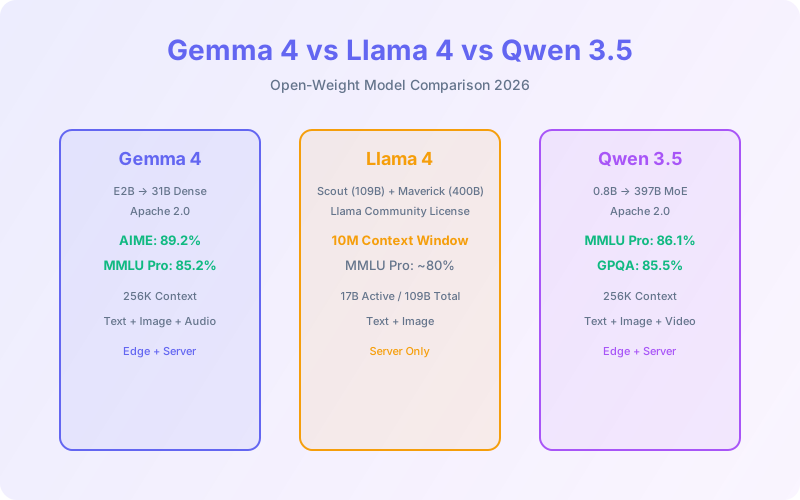
Gemma 4 vs Llama 4 vs Qwen 3.5 open-weight AI showdown
2 weeks ago