Honor Robot Phone showcases Augmented Human Intelligence at MWC
TL;DR
On March 5, 2026, Honor CEO Li Jian used the main stage at MWC Barcelona to present the company’s “Augmented Human Intelligence” (AHI) vision and debut its Robot Phone. The device integrates an embodied robotic arm, multimodal AI agent and flagship imaging system, pitched as a new class of human‑centric AI terminal.
About this summary
This article aggregates reporting from 3 news sources. The TL;DR is AI-generated from original reporting. Race to AGI's analysis provides editorial context on implications for AGI development.
Race to AGI Analysis
Honor’s Robot Phone is less about matching frontier model capability and more about reimagining the endpoint for AI. By putting a four‑degree‑of‑freedom robotic arm, multimodal perception and an on‑device agent into a mass‑market phone form factor, Honor is betting that “AI terminals” become as important as cloud models in the value chain. The AHI framing—personal intelligence on device, global intelligence in the cloud, and edge intelligence in physical robots—echoes how many labs now think about agentic systems.
For the race to AGI, this matters because it shows a major Chinese consumer brand designing hardware around embodied, agentic AI rather than just adding a chatbot button. If Robot Phone and its successors gain traction, they create a large installed base of mobile embodied agents with cameras and actuators, which in turn generates rich interaction data and real‑world feedback loops. That data is extremely valuable for training robust, tool‑using, real‑world‑aware models.
Honor’s move also intensifies competition with Samsung, Apple and Chinese peers to define what an “AI‑native” phone looks like. While it doesn’t move the fundamental capabilities frontier by itself, it helps pull those capabilities into everyday devices and pushes other OEMs to accelerate their own embodied and multimodal roadmaps.
Who Should Care
Related News

OpenAI GPT-5.5 ‘Spud’ leaks hint at omnimodal, agentic frontier model
1 weeks agoDeepSeek V4 to run fully on Huawei Ascend AI chips
2 weeks ago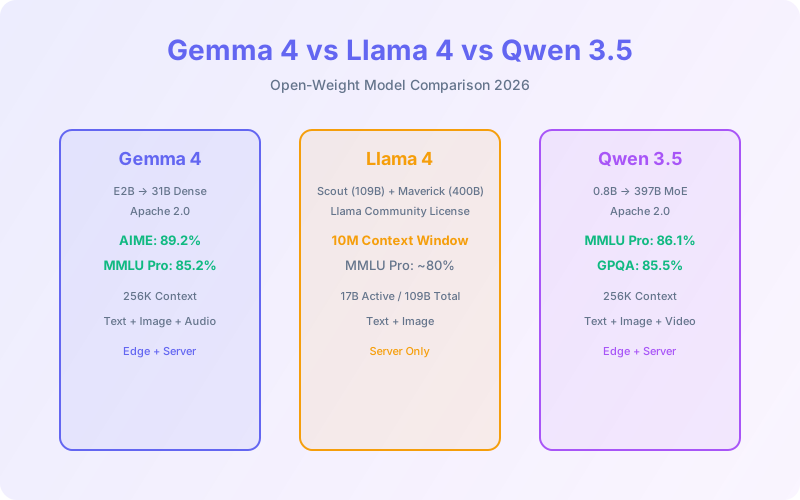
Gemma 4 vs Llama 4 vs Qwen 3.5 open-weight AI showdown
2 weeks ago