Huawei unveils iFTTO AI campus networking at MWC Barcelona 2026
TL;DR
On March 4, 2026, Huawei announced its new iFTTO solution at MWC Barcelona, an AI‑enhanced optical campus network architecture designed to support intelligent operations in education, healthcare and hospitality. The system fuses optical networking with multi‑modal sensing and AI agents for operations and maintenance.
About this summary
This article aggregates reporting from 1 news source. The TL;DR is AI-generated from original reporting. Race to AGI's analysis provides editorial context on implications for AGI development.
Race to AGI Analysis
Most of the oxygen at MWC goes to handsets and base stations, but Huawei’s iFTTO launch is a reminder that smart campuses will be one of the earliest mass‑market proving grounds for AI‑rich environments. By collapsing legacy multi‑layer campus networks into AI‑aware optical fabrics, Huawei is trying to own the substrate on which thousands of small‑scale, real‑time AI agents will run—controlling classrooms, dorms, clinics and hotels.
In the race to AGI, these kinds of deployments matter less for raw model breakthroughs and more for distribution. The more institutions build everyday operations around AI‑enhanced sensing and control loops, the more demand there will be for robust, low‑latency inference at the edge. That, in turn, justifies further investment in specialized accelerators, model compression and multi‑modal perception—ingredients that also support more capable agents.
Strategically, Huawei is signaling that it doesn’t just want to sell 5G and cloud; it wants to be the default nervous system for AI‑first campuses across the Global South and parts of Europe. If it succeeds, a large share of the next billion people’s first deep exposure to embedded AI may come through Huawei‑managed infrastructure, giving the company influence over standards, telemetry and the practical safety guardrails of ubiquitous AI systems.
Who Should Care
Companies Mentioned
Related News

OpenAI GPT-5.5 ‘Spud’ leaks hint at omnimodal, agentic frontier model
1 weeks agoDeepSeek V4 to run fully on Huawei Ascend AI chips
1 weeks ago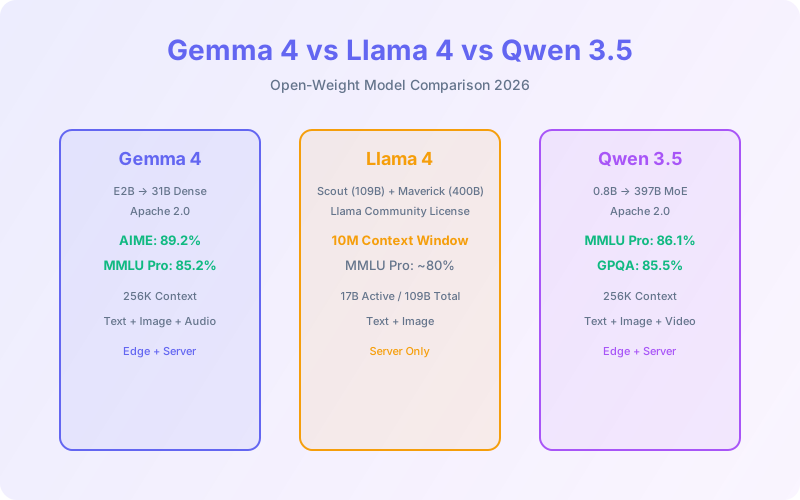
Gemma 4 vs Llama 4 vs Qwen 3.5 open-weight AI showdown
1 weeks ago