AAA debuts AI Arbitrator Resolution Simulator for legal dispute strategy
TL;DR
On March 4, 2026, the American Arbitration Association launched its Resolution Simulator, an AI‑powered tool that generates nonbinding simulated decisions for commercial and construction disputes based on user submissions. The system extends AAA’s existing AI Arbitrator engine to help legal teams assess potential outcomes before filing formal proceedings.
About this summary
This article aggregates reporting from 2 news sources. The TL;DR is AI-generated from original reporting. Race to AGI's analysis provides editorial context on implications for AGI development.
Race to AGI Analysis
The AAA’s Resolution Simulator is one more data point in a trend that should make the AGI community sit up: legal institutions are quietly starting to embed AI into their decision‑making workflows. Even though the tool is explicitly nonbinding, it invites lawyers to treat an opaque model’s reasoning as a proxy for how human arbitrators might decide a case. That’s a powerful nudge toward algorithmic authority in a domain where precedent, nuance and legitimacy matter as much as raw accuracy.
From an AGI‑race viewpoint, the implications are twofold. First, the legal domain is an unusually rich testbed for advanced reasoning models: dense text, high stakes, adversarial inputs and long‑horizon consequences. As more disputes are run through simulators like this, labs gain both training data and feedback signals about what counts as “plausible legal reasoning.” Second, there’s a governance risk: if practitioners over‑defer to these tools, we may entrench particular modeling assumptions or biases into legal culture well before we have models with genuine understanding.
Strategically, AAA’s move shows that traditional institutions won’t wait for AGI to start operationalizing AI. They will adopt narrow tools that fit specific pain points—here, early‑stage case evaluation—and then expand their use as comfort grows. That bottom‑up adoption curve will shape expectations about explainability, accountability and error tolerance long before any general intelligence arrives.
Who Should Care
Related News

OpenAI GPT-5.5 ‘Spud’ leaks hint at omnimodal, agentic frontier model
1 weeks agoDeepSeek V4 to run fully on Huawei Ascend AI chips
1 weeks ago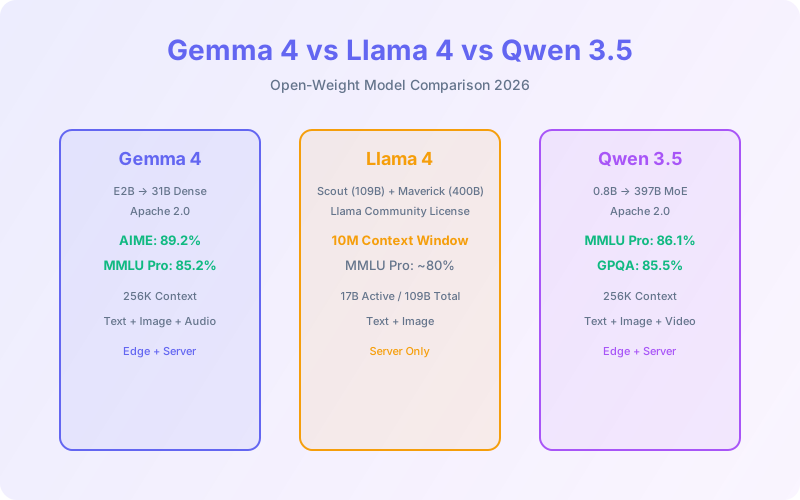
Gemma 4 vs Llama 4 vs Qwen 3.5 open-weight AI showdown
1 weeks ago